
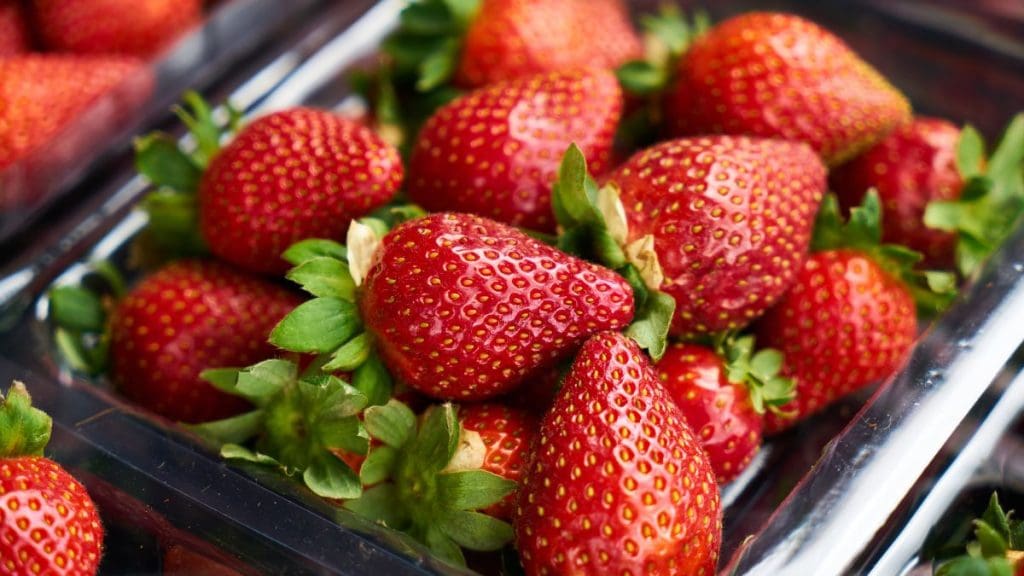
Strawberries on Canadian shelves can look, taste, and behave so differently from one purchase to the next that it can be confusing to know which ones to buy. Unlike apples, Canadian strawberries are not typically sold by individual variety name at the grocery store, so the more useful question is not “which variety should I buy?” but “which type and which growing method?” Strawberries in Canada fall into three main types based on when they fruit, and they reach Canadian shoppers through two main production methods. Knowing the difference helps explain why the same fruit can feel like a different experience in early June versus late September, and helps you pick the right strawberries for snacking, baking, jam, or freezing.
How to Read This Guide
This guide focuses on types and production methods, not on individual varieties, because Canadian shoppers rarely choose strawberries by variety at the store the way they pick a Honeycrisp or a Granny Smith. Each section below covers:
- What the type or production method is.
- Typical availability in Canada.
- Taste and texture in general terms.
- Common Canadian-grown varieties in each category, for context.
- Best uses (snacking, baking, jam, freezing, salads).
Availability windows reflect typical patterns from key producing regions and are not guaranteed. They can shift from year to year based on weather and growing conditions, and the same berry can taste slightly different depending on the sunshine and rainfall during ripening. For the broader picture of when strawberries are in season in Canada, see Strawberries in Season in Canada.




The Three Main Types of Canadian Strawberries
Most Canadian-grown strawberries fall into one of three types based on when and how they produce fruit. The type explains far more about what you are buying than the specific variety name.
June-Bearing
June-bearing strawberries produce one short, concentrated harvest of roughly three weeks, usually in June or early July. Berries are typically large, deeply coloured, intensely flavoured, and on the softer side. This is the type many Canadians grew up associating with “strawberry season,” and the type most U-pick farms feature.
Common Canadian-grown June-bearing varieties include Annapolis, Wendy, Honeoye, Jewel, Glooscap, and Kent across Ontario, Quebec, and Atlantic Canada, and Hood, Totem, and Rainier in British Columbia. You will rarely see these names on a clamshell, but you might see them at a U-pick farm sign or a farmers’ market chalkboard.
Day-Neutral
Day-neutral strawberries flower and fruit continuously through the warmer months because they are not tied to day length the way June-bearing varieties are. According to the Ontario Ministry of Agriculture, day-neutrals form flower buds under any day length and continue producing as long as temperatures are suitable, with production peaks roughly every six weeks from June onwards. Berries are typically smaller than June-bearing types but spread the local season across many months and tend to have a more consistent appearance.
Common Canadian-grown day-neutral varieties include Tribute and Tristar, identified by the Ontario Ministry of Agriculture as the higher-yielding day-neutrals in eastern North America, alongside Albion, Seascape, and Selva, which are widely grown in British Columbia and used in some Ontario and Quebec plantings.
- Typical harvest: late May through October.
- Best for: fresh eating, snacking, lunchboxes, and salads through the summer.
Greenhouse-Grown
Greenhouse-grown strawberries are produced indoors in climate-controlled environments. They are typically day-neutral varieties chosen for their ability to produce reliably year-round under managed light, temperature, and water. According to Statistics Canada, Canadian greenhouse strawberry production grew from about 2.6 million kilograms in 2020 to more than 7.5 million kilograms in 2024, supporting year-round availability of Canadian-grown berries even when field-grown berries are not in season. Albion is one of the day-neutral varieties commonly grown in Canadian greenhouse operations.
- Typical availability: year-round.
- Best for: off-season fresh use when locally grown Canadian field berries would otherwise not be available.
The Two Main Production Methods
The same three types of strawberries can also be sorted by how they are physically grown. Field and greenhouse are the two main production methods you will encounter in Canada, and they shape the flavour, appearance, season, and price of the berries that reach your kitchen.
Field-Grown
Field-grown strawberries are produced outdoors on Canadian farms across Quebec, Ontario, British Columbia, the Atlantic provinces, and parts of the Prairies. Most field-grown strawberries are planted on raised beds with drip irrigation, often covered with plastic mulch to manage soil temperature, reduce weeds, and keep berries cleaner as they grow. Because strawberries bruise easily and ripen at different stages, they are still hand-picked in Canada, often across multiple passes through the same field as different berries reach maturity.
Field-grown berries are the type you find at U-pick farms, farmers’ markets, and farm stands during peak season. Flavour intensity is influenced by sunshine during ripening, which is why field-grown strawberries at the height of June and July often taste noticeably stronger and sweeter than berries from any other source. Both June-bearing and day-neutral varieties are grown in fields.
- Typical availability: late May through October (peak in June and July).
- Best for: fresh eating, U-pick, jam, freezing at peak season.
Greenhouse-Grown
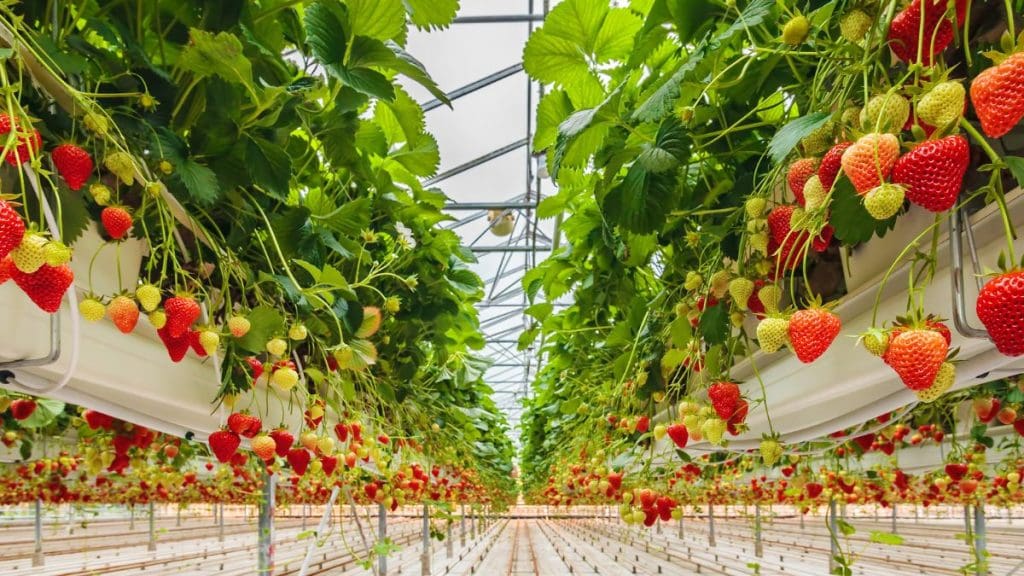
Greenhouse-grown strawberries are produced indoors in climate-controlled environments where temperature, lighting, water, and nutrition are all managed. This level of control allows year-round production and very consistent fruit quality. Statistics Canada reports that the total area dedicated to greenhouse strawberry production in Canada nearly tripled between 2020 and 2024, growing from about 304,000 square metres to nearly 840,000 square metres.
Greenhouse berries are often very uniform in size, shape, and ripeness, with strong shelf life. Flavour can be slightly less intense than peak-season field berries grown in full sun, since flavour is influenced by sunshine during ripening. When the choice is between Canadian-grown greenhouse strawberries and field strawberries imported from outside Canada, greenhouse-grown is often the fresher, lower-mileage option.
- Typical availability: year-round.
- Best for: off-season fresh use, especially when the only field-grown alternative is imported.
How to Choose Strawberries by Use
The simplest way to choose the right strawberries is to start with the use and work back to the type and method.
- If you want fresh strawberries at their flavour peak: look for field-grown, June-bearing strawberries during June and July, whether at the grocery store, farmers’ market, or U-pick farm.
- If you want consistent strawberries for lunches and salads through the summer: look for field-grown, day-neutral strawberries from late May through October.
- If you want to make jam or freeze a batch: buy field-grown, June-bearing strawberries by the flat at peak season. Buying at peak is also when you are most likely to find favourable pricing, which is covered in Seasonal Strawberries and Your Grocery Budget in Canada.
- If you want Canadian strawberries outside the field season: look for greenhouse-grown berries with Canadian labelling, generally available year-round.
- If you want one type for everything and do not want to overthink it: field-grown June-bearing in June and July, and field-grown day-neutral or Canadian greenhouse strawberries for the rest of the year.
Regardless of type or method, choose berries that are deeply coloured, firm but not hard, and fragrant, with fresh-looking green caps. For full storage guidance once you get them home, see How to Store Strawberries to Cut Food Waste. For recipe ideas across snacking, salads, baking, and smoothies, see Easy Ways to Use Strawberries.
Where to Find Canadian Strawberries
Canadian strawberry growers across Quebec, Ontario, British Columbia, and the Atlantic provinces grow combinations of these types using both production methods, so the freshest local berries near you depend on where in Canada you live. During field season, look for “Product of Canada” labels, provincial origin logos such as Foodland Ontario and BC Strawberries, Quebec strawberry markers from APFFQ and Les Fraîches du Québec, and signage at farmers’ markets and farm stands. U-pick farms in the Fraser Valley, southern Ontario, Quebec, and Atlantic Canada also offer some of the freshest available strawberries during peak season.
For more information on Canadian strawberry growers and their organizations, see Berry Growers of Ontario, the BC Strawberry Growers Association, or APFFQ and Les Fraîches du Québec. For more on how Canadian strawberry farms operate from planting through harvest, see How Do Strawberries Grow?
Additional Articles to Explore





 Seasonal Strawberries and Your Grocery Budget in Canada
