
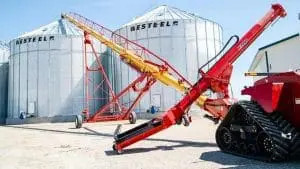
A big part of a farmer’s job is to move grain like oats, wheat, barley and canola. This doesn’t happen just once on the farm. Grain is moved from the combine (which harvests the grain) to the grain cart or truck, from the truck to the grain bin for storage, and then from the grain bin to the truck to the grain elevator or processing facility for sale.
Grain augers are vital tools for this process—designed to move grain quickly and efficiently from one place to another.
The anatomy of a grain auger
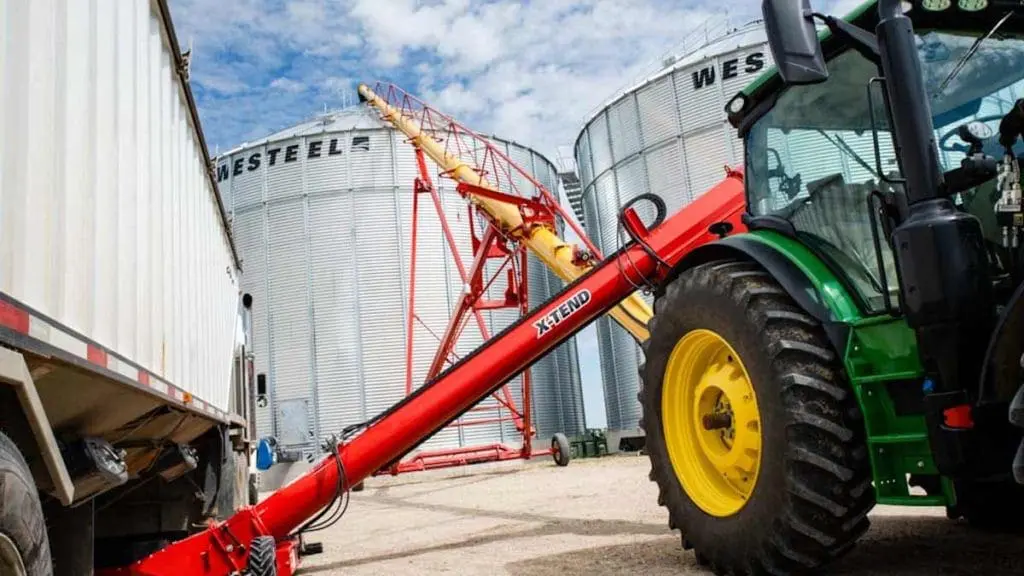
The general structure consists of a flat steel helical spiral called flighting attached to a long shaft contained in a large tube. As the spiral turns, it lifts grain up through the auger tube to the top where grain is discharged. At this point gravity takes over and the kernels fall into a storage container, most often a bin, silo or truck.
At the base is a hopper, where grain is fed into the auger. A drive motor connected to the system turns the flighting, which picks up and moves the grain from the hopper to the discharge end. Depending on the configuration of the system, the material can be moved horizontally or diagonally to accommodate different types of grain.
Grain augers are most often powered by an electric motor, power take off on a tractor or through an internal combustion engine mounted on the auger.
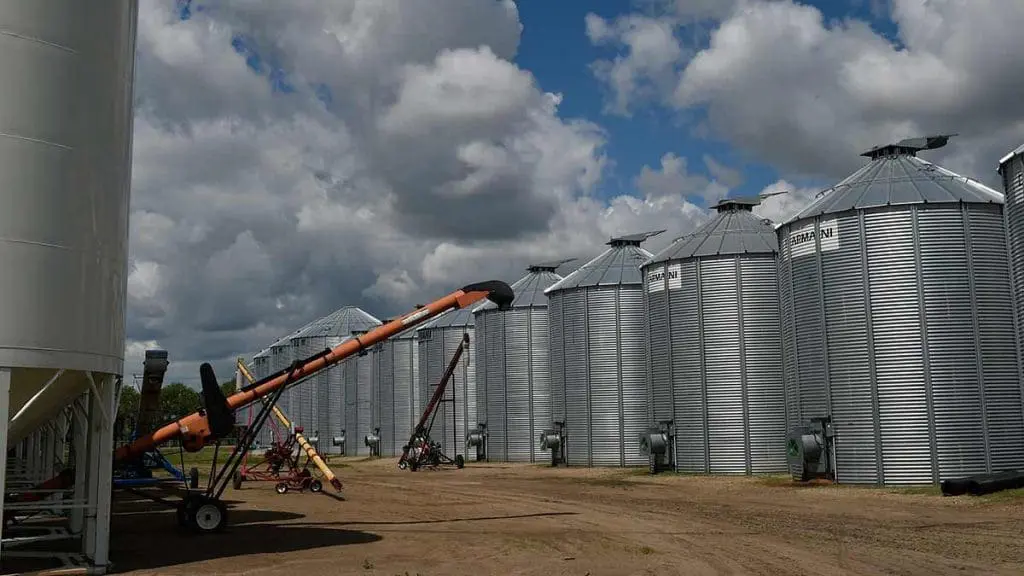
A “bushel” is a volume measurement of grain. It is used to describe a crop’s yield per acre, the amount of grain that fits in a bin or how much grain will be sold. Auger capacity refers to how many bushels an auger can move. Some of the largest augers can move more than 23,000 bushels per hour!
Fun fact: Grains can have different densities and bushel weights!
Many options and a variety of sizes
Just like any farm implement, there are a wide variety of options and sizes of augers. The type and size a farmer selects depends on its use.
- Portable versus stationary – Portable augers can be transported by way of the wheels attached to the bottom. This type of auger can be moved around to be used at multiple different locations on the farm. Stationary augers never move. They’re often used to move grain through a series of bins.
- Size and volume – The diameter of the tube can range from 8 inches all the way up to 16 or 20 inches. The larger the width, the more grain it can transfer at one time.
- Conveyor versus flighting – Some grains require a gentle touch, and sometimes the flighting can damage delicate seeds. Conveyors are a gentler option which carries product on a belt.
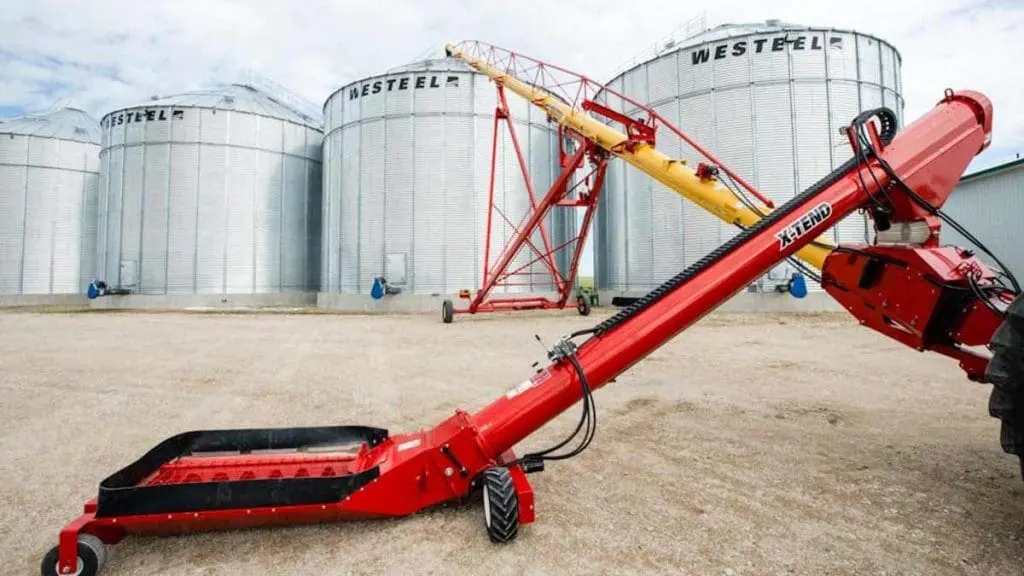
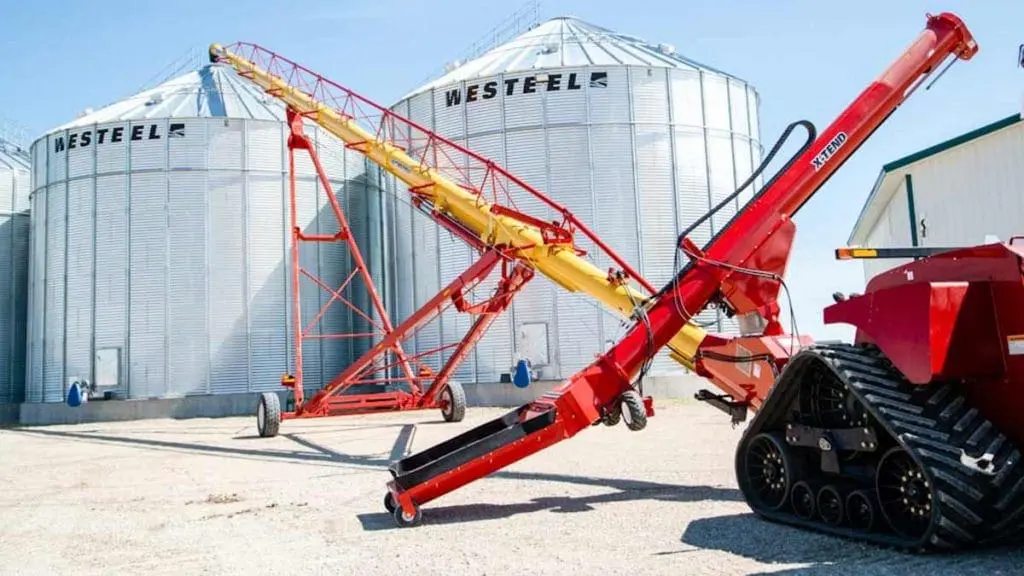
- Height – As farm size grows, the volume of grain storage required on farms increases. That means each farm needs more and bigger grain bins. Some bins can be as high as 50’ tall. That’s the same as a 5-story building! This also means taller augers are required to get grain into the bin itself. These augers must be at least as high as the top of the bin and have a length of up to 155 feet!
A Canadian innovation
Before grain augers, farmers had to rely on dumping grain from one container to another or manually moving it by shovelling, which was an onerous and backbreaking task.
In the early 1940s, Canadian Peter Pakosh approached the team at Massey Harris (later Massey Ferguson) with an innovative idea to move grain. He was mocked and told it was an “unimaginable” idea. He persevered, however, and in 1945 built a prototype that would later be refined to sell thousands of units across North America, forever changing the agriculture industry.
Augers and safety
Like many occupations that involve machinery, farming can be dangerous if safety protocols aren’t carefully followed. Farmers have to be careful when using augers.
Most farmers fight against the clock to get the crop in before Mother Nature and winter damage the quality of the crop being harvested. It is an intense period of several weeks when they often get little sleep or days off and are often stressed and overwhelmed. It is not uncommon for farmers to forget to lower an auger during transport, which can touch power lines and cause electrical shock, resulting in death or dismemberment.
In addition, while the grain auger is a vital part of any grain farm, it is also ruthlessly good at its job. Many farmers have lost limbs or their lives by becoming entangled with augers.
More information on this topic:
- Saskatchewan Distance Learning Centre: Resource Bank
- Agriculture in the Classroom
- Ask a Farmer: What is an auger?
 BBQ Bean & Oat Burgers