

Growing eggplants using AI, bees, and innovative greenhouse technology
Most Canadians may be surprised to find out eggplants are grown year-round in Canada and this purple powerhouse is growing in popularity.
How are eggplants grown in Canada?
Eggplants grow in fields and greenhouses, mainly in Ontario but there is some smaller field production in British Columbia, Alberta, and Quebec. Field-grown eggplants are typically transplanted after May 24 and available for up to three months.
However, greenhouse-grown eggplants are available almost all year long from the middle of February to the end of November. Eggplants represent about 0.6 per cent (or approximately $16.7 million) of Canada’s total greenhouse production.

What are eggplants?
Eggplants were cultivated in India for 4,000 years and then trade routes introduced the fruit – yes fruit, because of its seeds inside – to different countries. It is also a member of the nightshade family, related to tomatoes, potatoes, and peppers.
There are many varieties of eggplant, some long and purple, and some short and white, resembling an egg, which is where the name came from. Eggplants are packed with nutritional value and are low in calories, making them a healthy addition to any plate.
There’s a growing market for eggplants in Canada because of immigration and evolving food cultures and eggplant consumption (particularly exotic varieties) is forecasted to increase by 130 per cent by 2030.
Did you know? Eggplant is a fruit! The seeds on the inside are a telltale sign that classify eggplant as a fruit. However, chefs treat eggplants as “vegetables” because of their savoury taste. Science says fruit; chefs say vegetable, and both are right!
Meet an eggplant grower
Michael Del Cianco’s family farm grew fruits and field crops in Kingsville, Ontario until his parents decided to build three acres of greenhouses in 1995. At first, he resisted his desire to farm, detouring to work in the music industry in Toronto. “I quickly realized that [music] is not as fulfilling as I wanted it to be, and everything is ultimately business at the end of the day. And once I had that realization, I was like, well, there’s nothing quite as rewarding as growing food for people,” Del Cianco says.

He returned to greenhouses filled with tomatoes and cucumbers, but has since been transitioning to specialize in eggplants. “There’s a lot of larger farms around here and I need to find kind of a niche to separate myself,” Del Cianco says. “I enjoy growing eggplant. Every plant has a feeling to it and eggplant is relaxed; it’s got a chill feeling to it.” Now Del Cianco’s DC Farms produces 1.6 million pounds of eggplants per year.
How do eggplants grow?
The eggplants arrive in mid-February as 52-day old transplants instead of starting from seeds. DC Farms also uses grafted plants, so eggplant on tomato rootstock, for stronger root systems and plant health.
After the first flower emerges, bees are brought in to help pollinate the eggplant and Del Cianco explains that hives are brought in every other week during the growing season. “I get stung but it’s nothing crazy. Oftentimes they bounce right off your head. They’re more like bumblebees instead of yellow jackets… for the most part, if you let them be, they’ll let you be,” Del Cianco says.
Approximately 50 days after planting, the eggplants are ready to be picked. Eggplants are harvested daily through to the end of November and you can harvest so often because you are picking at different points within a vine as the eggplants grow and ripen. At the end of their lifespan, an eggplant plant is 15-feet tall, compared to a tomato plant which is 38-feet tall.

Eggplant challenges
As one of the less popular nightshades, eggplants typically receive less research and marketing attention, but they do attract attention elsewhere: pests. Thrips, aphids, spider mites, and whiteflies are all pests that are drawn to eggplants. “That’s the one downside of eggplant. They get a lot of pests… they get everything,” Del Cianco says.
He runs a comprehensive IPM (integrated pest management) program with sticky tape, beneficial insects, biologicals, and banker plants. The banker plants are planted at the end of rows, typically a flower like Alyssum, and they act as hosts for pests and protectors for the eggplant.
“You worry about the heat in the winter, you worry about the water in the summer,” Del Cianco says, adding that the challenges build character but also help to keep him and his many interests dialed in and engaged.
Using AI to grow eggplants
While artificial intelligence probably cannot pick an eggplant off the vine, it does have a role to play in the greenhouse. “Everything is about optimization and dialing it into the nth degree. We’re very data-driven,” Del Cianco says. “It’s [AI] operating 50 per cent of my farm this year… I’m keeping a close eye on it. Every five minutes, it’s adjusting my temperatures and my environment for my plants.”
Del Cianco shares a case study they did with a utilities company where they had AI run half the greenhouse and himself run the other half. The result was that AI achieved more production with slightly less gas usage. “Those are the type of things I believe agriculture needs to speak more to, how we use data to back up what we’re doing,” Del Cianco says.
From greenhouse to your table
If you shop at Costco, there is a good chance you have seen eggplants from DC Farms. The 200-gram eggplants are packaged four in a bag and 60 per cent of them are destined for Costco Canada, whereas the rest go to other Canadian and American retail outlets.
“I pack it immediately. Everything is shipped out same day so typically I pack right after we’re done picking and I deliver to [the distributor,]” Del Cianco explains. The eggplants get a barcode and a date so the product can be traced back to the farm for food safety. The typical shelf life for eggplant is two to three weeks.
Eggplant in the kitchen
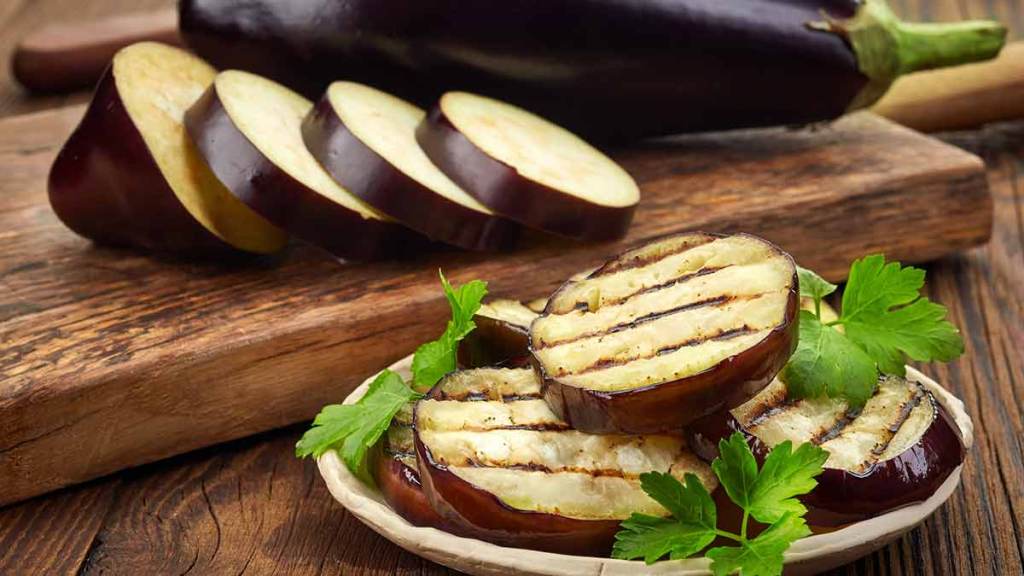
You can find eggplant in baingan bharata, a popular north Indian eggplant curry dish, and trace its trade routes through all the other popular eggplant dishes like baba ganoush, Greek mousakka, and eggplant parmesan. It can also be enjoyed simply grilled.
For Del Cianco, breaded eggplant fries are his personal favourite. “Wherever you put meat, try throwing in a little bit of eggplant,” Del Cianco says. “Experiment and have fun with it.”
Additional Articles to Explore



 Frittata Frenzy: Feed a Crowd, Tame Your Fridge
