

Rhubarb is one of Canada’s first fresh crops of the year, a seasonal signal that spring has truly arrived. This page covers everything you need to know: when Canadian rhubarb is available, where it’s grown, the difference between field and hothouse types, how to buy and store it, what it offers nutritionally, and how it goes from farm to table. Whether you’re picking up a bunch at the farmers’ market or grabbing it at your grocery store, here’s what to expect from this uniquely Canadian crop.

At a Glance — When Is Rhubarb in Season in Canada?
Rhubarb is one of the earliest crops in the Canadian food calendar, and availability depends on whether it’s field-grown or hothouse-grown.
Quick snapshot:
- Hothouse rhubarb: Available as early as January through to June
- Field rhubarb: Typically available May through June, and sometimes into July
- Overall Canadian crop window: Roughly April – July
- Timing varies by province, growing conditions, and the year’s weather so always check with your local retailer or market
Rhubarb is not typically stored long-term the way some crops are. What you see in stores largely reflects what’s freshly harvested, making it a genuinely seasonal buy. You’ll find rhubarb featured in our What’s in Season: May guide and in the What’s in Season in Canada hub.




Where Is Rhubarb Grown in Canada?
Commercial rhubarb production in Canada is concentrated in British Columbia, Ontario, and Nova Scotia. Statistics Canada data from 2022 shows BC farmers accounted for over half (55.4%) of the rhubarb grown in Canada, producing 693 tonnes. Ontario and Nova Scotia have long-established growing regions as well, with the Atlantic climate particularly well-suited to rhubarb’s preference for cool seasons and cold winters.
Rhubarb is also well-suited to prairie climates and is grown in home gardens and on small farms across the country.
Field Rhubarb vs. Hothouse Rhubarb — What’s the Difference?
Not all rhubarb at the store is the same. The two main types reflect very different growing conditions, and knowing the difference helps you choose the right one for your needs.
Field rhubarb
- Grown outdoors in sunlight, resulting in thicker stalks and darker green leaves
- The interior of the stalk is lighter green and more fibrous
- Typically available May – June, sometimes into July
- Bolder, more tart flavour; best for cooked applications like pies, crisps, and jams where texture softens with heat
Hothouse rhubarb (sometimes called winter rhubarb)
- Grown in darkened, temperature-controlled sheds that trick plants into early growth
- Produces thinner, deep-red stalks that are pink all the way through with finer fibre strands
- Available as early as January through to June
- More tender and sweeter than field rhubarb; works beautifully in recipes where colour and delicacy matter
The colour of the stalk indicates variety and growing conditions, not ripeness. A green stalk is not under-ripe; it may simply be a different variety or field-grown.
How to Buy Rhubarb
When purchasing rhubarb, keep these points in mind:
- Buy stems only — rhubarb leaves are inedible. They contain a high concentration of oxalic acid, which in large doses is toxic to humans and animals. If the leaves are attached, they should be removed before storage.
- Look for firm, shiny stalks — avoid anything limp, wrinkled, blemished, or with split ends.
- Thinner stalks tend to be more tender — younger, redder stalks are generally less fibrous and slightly sweeter than thick, mature ones.
- For eating fresh or light cooking: Choose forced/hothouse rhubarb, it’s more tender and sweeter.
- For pies, crisps, jams, and sauces: Field rhubarb works well; its bolder tartness holds up beautifully when cooked.
- Check the label: Look for “Product of Canada” or provincial origin labelling where shown at your retailer.
If you’re harvesting from your own garden, wait until stalks are at least 30 cm high. Grasp near the base and twist to pull; this allows a new stalk to regrow in its place. Harvest only for one to two seasons from a new plant to let it establish before full harvesting begins.
Check out Canadian Rhubarb Varieties and Best Uses for more cooking tips. Curious when rhubarb will make the most impact on your grocery budget? Learn more in Seasonal Rhubarb and Your Grocery Budget.
How to Store Rhubarb
Proper storage helps rhubarb stay fresh and cuts down on waste. Here’s a quick guide:
Before storing:
- Remove leaves immediately and discard them
- Wash stalks and pat dry
- Remove any surface blemishes with a sharp knife
- Do not cut the stalks until you’re ready to use them as cutting causes them to dry out faster
Refrigerator:
Uncut stalks can be stored in the fridge for up to 7 days. Keep them in the crisper drawer, loosely wrapped or in a ventilated bag.
Freezer:
Rhubarb freezes exceptionally well, one of its most practical qualities. To freeze:
- Wash and cut stalks into ¼ inch or ½ inch slices
- Spread in a single layer on a parchment-lined baking sheet; don’t overcrowd
- Freeze for at least 4 hours
- Transfer to an airtight container or freezer bag
- Properly packaged, rhubarb keeps in the freezer for up to 1 year
Frozen rhubarb can go directly into smoothies, crisps, and muffins without thawing.
Easy Ways to Use Rhubarb
Rhubarb’s tartness makes it one of the most versatile seasonal ingredients in Canadian cooking, well beyond the classic strawberry-rhubarb pie. Here are some simple ways to use it:
- Classic desserts: Rhubarb pie, crumble, crisp, or a simple galette — the tartness balances beautifully with a sweet filling.
- Jams and preserves: Rhubarb cooks down quickly and sets well; a simple strawberry-rhubarb or rhubarb-ginger jam is an easy preserve for beginners
- Compote or sauce: Stew chopped rhubarb with a little sugar and serve over yogurt, oatmeal, or pancakes
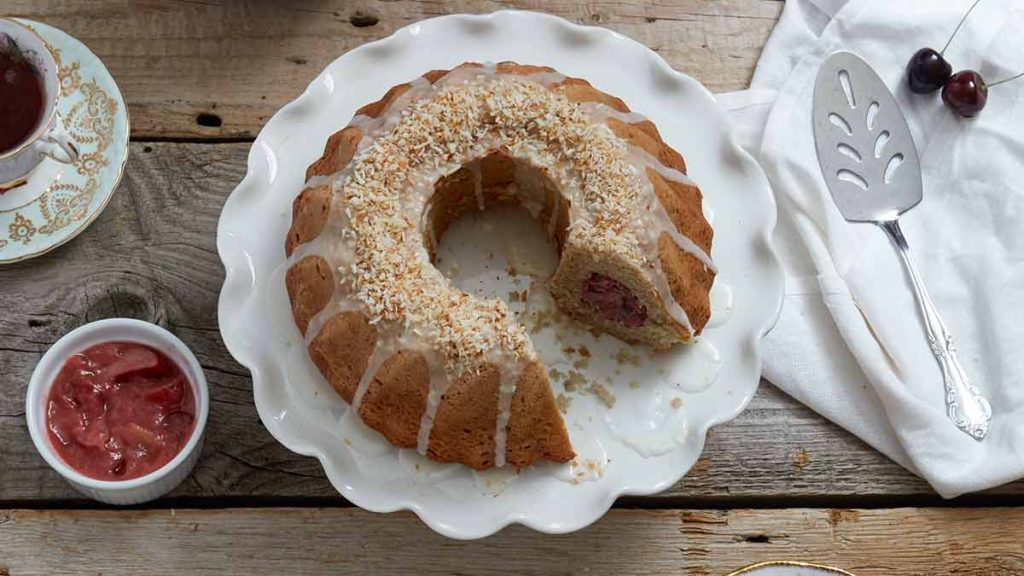
- Baked goods: Fold chopped rhubarb into muffins, loaves, or cakes – like this Cherry Rhubarb Bundt Cake
- Savoury uses: Rhubarb’s acidity works in chutneys, BBQ sauces and glazes for pork or chicken — try it as you would a tart cranberry sauce
- Fresh: Young, tender, forced rhubarb stalks can be eaten raw, dipped in sugar — a nostalgic Canadian springtime snack
There is generally no need to peel rhubarb. However, the stems of wild or mature field-grown rhubarb can be quite fibrous. To remove fibrous strands: cut a small slit at one end of the stalk and peel the skin back to pull the stringy fibres away with it.

Important: Never cook rhubarb in aluminum, iron, or copper pans. The acidity of rhubarb reacts with these metals and can discolour your cookware. Choose pans made of:
- Enamelled cast iron
- Anodized aluminum
- Nonstick-coated aluminum
- Glass
Rhubarb Nutrition at a Glance
Rhubarb is a very low-calorie vegetable with a modest but genuinely varied nutrient profile. A 250 mL (approximately 1 cup / 129 g) serving of raw, diced rhubarb contains approximately 27 calories, making it one of the lightest seasonal vegetables in the spring produce aisle.
A few notes:
- Rhubarb provides a meaningful amount of Vitamin K — a nutrient that supports normal blood clotting and bone health. Per 100 g of raw rhubarb, Vitamin K content is approximately 29.3 µg
- Its calcium content is noteworthy: one cup provides roughly 266 mg of calcium — comparable to a glass of milk. However, rhubarb also contains oxalic acid, which binds to calcium in the digestive tract and significantly reduces how much is actually absorbed
- Rhubarb is a reasonable source of Vitamin C and potassium, and contains small amounts of folate, Vitamin E, and zinc
- Nutrient values vary by variety, freshness, and growing method (field vs. forced/hothouse), and differ between raw and cooked rhubarb
How Rhubarb Is Grown in Canada
Rhubarb is a perennial crop and once established, the same plant can be harvested for 8 to 10 productive years. It thrives in Canada’s temperate climate and actually benefits from long, cold winters, which are part of what makes it so well-suited to Canadian growing conditions.
In the Field
Farmers start by purchasing seedling plants from nurseries or by splitting sections of fibrous root from mature plants which is the most efficient way to propagate rhubarb. Root sections are planted in evenly spaced rows to allow the plants to spread to 3–5 feet at maturity. Many growers mulch with plastic covering to suppress weeds and retain heat and moisture, using irrigation to keep roots hydrated.
Rhubarb is relatively hardy, but farmers monitor crops for weeds, diseases, and insects. Flower stems are removed as soon as they appear to redirect the plant’s energy back into producing quality stalks. Flower stalks can grow up to 4 feet high if left unchecked.
A young rhubarb plant is not harvested in its first year or two; this establishment period is critical for long-term productivity.
Harvest
In both field and forced settings, stalks are pulled from the plant when they reach approximately 30–40 cm in length. Each plant can be harvested multiple times during the season, as individual stalks come into maturity at different times. Once harvested, rhubarb is hand-picked and packaged in boxes or bunched for direct-to-consumer sales.

Hothouse Rhubarb — Growing in the Dark
This centuries-old technique produces a distinctly different product. In fall, farmers dig up older, nutrient-rich rhubarb roots from outdoor fields and transplant them into heated barns with irrigation. Grown without light, the plants cannot photosynthesize, so they put all their energy into producing long, smooth, deep-red stems that are more tender and sweeter than their outdoor counterparts. Harvest of forced rhubarb starts approximately 4 weeks after growing begins and can extend 6–8 weeks.
From Field to Store
Once harvested, rhubarb is stored in high-humidity coolers at 0°C, where it can retain quality for 2–4 weeks. Because rhubarb does not go into long-term controlled-atmosphere storage the way apples do, what you find in stores is a relatively fresh, seasonal product, making it one of the more genuinely “in season” items in the produce aisle during spring.
Canadian Crop Available: April – July
Grown in: British Columbia, Ontario, Nova Scotia



 How to Make a Flax Egg
