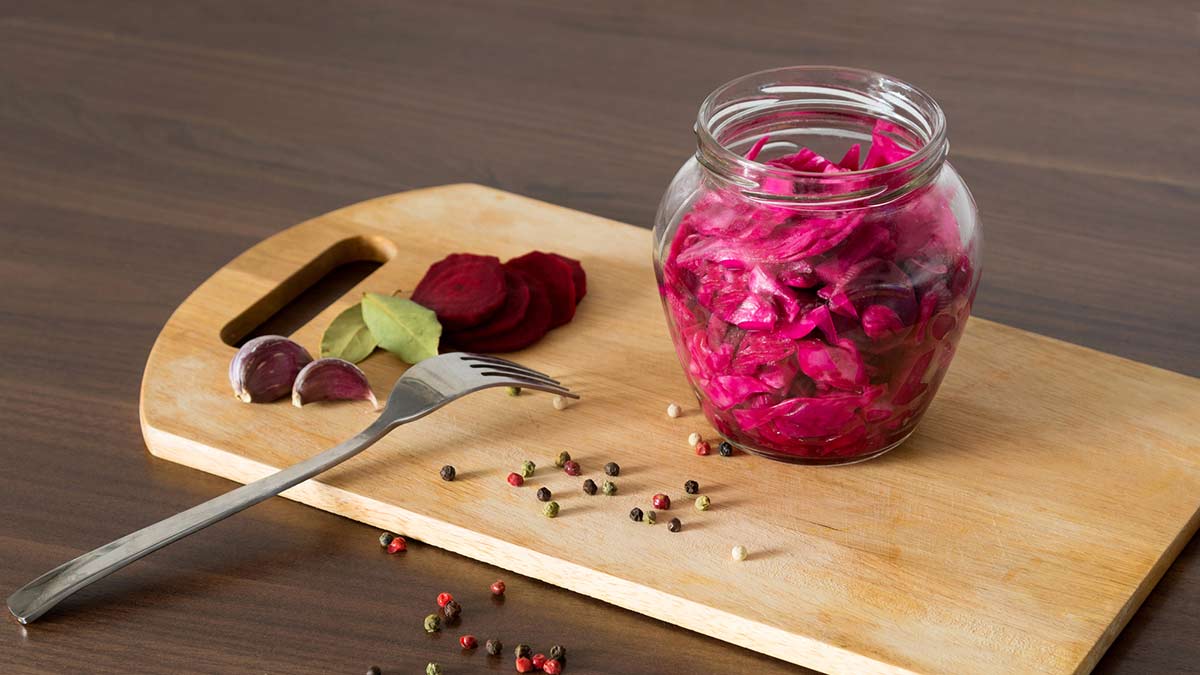
Beet Sauerkraut
Delicious on salads, grain bowls, sandwiches, or eaten straight from the jar, this kraut adds colour, crunch, and a boost of nourishment to any meal.
Print
Pin
Email
Share
Servings: 12 servings
Ingredients
Instructions
Prepare the Vegetables
- Remove outer leaves from cabbage if damaged.
- Remove core, rinse cabbage and slice or shred evenly.
- Wash beets (do not peel) and grate.
Salt & Massage
- Place cabbage and grated beets in a large bowl.
- Sprinkle with salt and caraway seeds (if using).
- Toss to distribute salt.
- Pound and squeeze vegetables until volume is reduced by about half and liquid brine forms in the bowl.
Pack the Jar
- Pack vegetables and brine tightly into a clean quart jar.
- Press down firmly so brine rises above the vegetables.
- Add a fermentation weight or cabbage core to keep vegetables submerged.
- Leave at least 1 inch headspace.
Ferment
- Add fermentation lid or loosely fitted regular lid.
- Place in a cool, dark place.
- Check daily for the first few days, then every other day.
- Remove any floating vegetables or seeds.Note: Fermentation may happen more quickly due to the natural sugars in the beets.
Taste & Store
- Taste after 2 weeks.
- Continue fermenting until desired sourness is reached.
- Once finished, refrigerate.Yield: 1 quart jarPrep time: 15-25 minutesFerment Time: 14-20 days
Video
Nutrition Facts
Beet Sauerkraut
Serving Size
1 serving
Amount per Serving
Calories
23
% Daily Value*
Fat
0.1
g
0
%
Saturated Fat
0.03
g
0
%
Sodium
615
mg
27
%
Potassium
160
mg
5
%
Carbohydrates
5
g
2
%
Fiber
2
g
8
%
Sugar
3
g
3
%
Protein
1
g
2
%
* Percent Daily Values are based on a 2000 calorie diet.